
WUF13 Azerbaijan
Third Azerbaijan National Urban Forum kicks off in Khankendi
The opening ceremony of the 3rd Azerbaijan National Urban Planning Forum was held in Khankendi
Khankendi,
2025, October 15
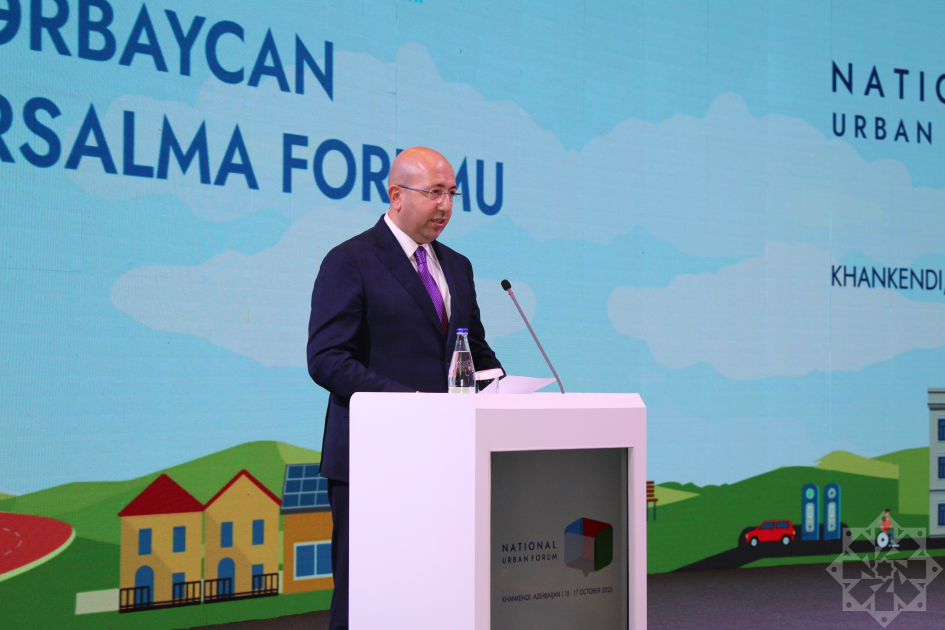
The 3rd Azerbaijan National Urban Forum, themed “Towards Climate-Resilient and Healthy Cities: Harnessing Regional Partnerships and Innovative Solutions,” opened in Khankendi on October 15.
Anar Guliyev, Chairman of the State Committee on Urban Planning and Architecture, read out President Ilham Aliyev's address to the forum participants.
“To the participants of the Third National Urban Forum of Azerbaijan
Dear Forum participants!
I welcome you on the occasion of the opening of the Third National Urban Forum of Azerbaijan. Welcome to the city of Khankendi.
I welcome you to the city of Khankendi for the Third National Urban Forum of Azerbaijan. This event, held in Azerbaijan for the third time and already a growing tradition, brings together national, regional, and international partners in urban planning and serves as a vital platform for exchanging experiences, fostering new initiatives, and enhancing cooperation.
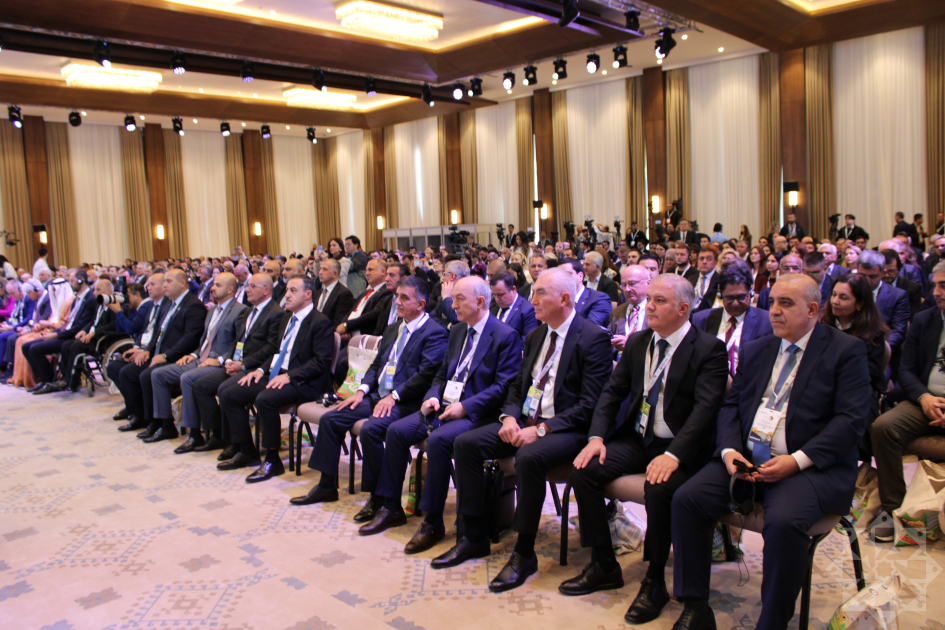
The National Urban Forums, organized in cooperation with UN-Habitat, are another vivid manifestation of Azerbaijan’s successful collaboration with international partners in this field. The participation of more than 200 foreign guests from over 60 countries, a total of about 400 representatives, signifies both the trust and friendship extended toward our country, as well as solidarity in pursuing common goals in urban planning.
Urban planning is a priority area in Azerbaijan’s national development strategy. The approaches adopted in urban planning and urbanization have contributed to economic sustainability, socioeconomic well-being, and adaptation to climate change. The large-scale restoration and construction underway, particularly in the Garabagh and East Zangazur economic regions, demonstrate the government’s strategic vision and capabilities in urban development.
Following three decades of occupation, Azerbaijani territories were left devasted, with historical and cultural heritage destroyed, lands contaminated with mines, and more than a million Azerbaijanis displaced from their homes. The victory in the 44-day Patriotic War of 2020 ushered in a period of restoration, reconstruction, and revival.
Today, Azerbaijan is implementing large-scale construction and reconstruction projects in Garabagh and East Zangazur. The comprehensive regional planning, covering 13,600 square kilometers, guides efforts to resettle more than 1.1 million people to their native cities and villages. Master plans for eight cities and 90 villages – home to more than 300,000 people – have been approved, and people have begun returning to six liberated cities, two settlements, and 20 villages.
By applying advanced urban-planning principles, systematic and coherent measures have been put in place to build sustainable infrastructure, rebuild settlements, and create conditions for the return of the population. Over the past four years, three new international airports have been built, along with modern roads and highways, new railway infrastructure, and ongoing construction of residential buildings, healthcare facilities, educational institutions, and other social infrastructure.
Special importance is attached to the reconstruction of energy infrastructure and the strengthening of energy security. Solar and wind energy projects are well underway in Garabagh and East Zangazur, designated as a “green energy” zone, with a capacity of up to 10,000 megawatts. Innovative approaches such as “smart city” and “smart village” are being applied, and ecosystem restoration is in progress.
The establishment of industrial parks and economic zones is underway to promote economic development and employment in the region. This contributes to the sustainable development of settlements by expanding local production opportunities and creating new jobs. With enhanced road connectivity, Garabagh and East Zangazur are now directly linked to Baku and other regions, accelerating their economic and social development. Today, about 60,000 people live, work and study in these areas under the “Great Return” program.
The decision to hold the Third National Urban Forum of Azerbaijan in Khankendi is especially significant. The city that endured occupation for many years is now a symbol of peace, restoration, and revival. The infrastructure projects currently underway in Khankendi support development aligned with the vision of a modern, smart, and innovative city.
The ongoing reconstruction in Garabagh and East Zangazur is important not only for urban and infrastructural development but also for establishing long-term peace and regional cooperation. Targeted projects, new partnerships, and a favorable economic environment are creating sustainable livelihoods for the local population and contributing to regional urban development.
Azerbaijan’s advanced experience in urban planning has attracted tremendous international interest. Our country is viewed as a reliable partner in addressing global challenges in climate change and urban planning, as well as in developing innovative approaches. International cooperation in this area, particularly through initiatives with UN Human Settlements Programme, is of great importance.
The decision to hold the 13th World Urban Forum in Baku in 2026 stands as clear evidence of Azerbaijan’s contribution to international urbanization processes and the trust it has earned as a reliable partner. This prestigious event will further enhance Azerbaijan’s role in global urbanization and contribute to the achievement of regional and global sustainable development goals.
Today’s Forum marks an important milestone on the path to the 13th World Urban Forum. I am confident that the discussions here will be instrumental in implementing strategic initiatives for urban planning, restoration, and sustainable city development, and will help create a greener, more inclusive, and prosperous living environment for future generations.
I welcome you all to Azerbaijan once again, and wish the Forum every success.
Ilham Aliyev
President of the Republic of Azerbaijan
Baku, 15 October 2025”
In her remarks, Anacláudia Rossbach, United Nations Under-Secretary-General and Executive Director of the United Nations Human Settlements Programme (UN-Habitat), described the forum as highly significant not only for Azerbaijan but for the entire region. She highlighted it as a valuable opportunity to advance the global urban agenda and promote multifaceted cooperation in building sustainable cities. Rossbach also commended the Azerbaijani government for its support in preparing for the upcoming 13th session of the World Urban Forum (WUF13) scheduled to be held in Azerbaijan in 2026.
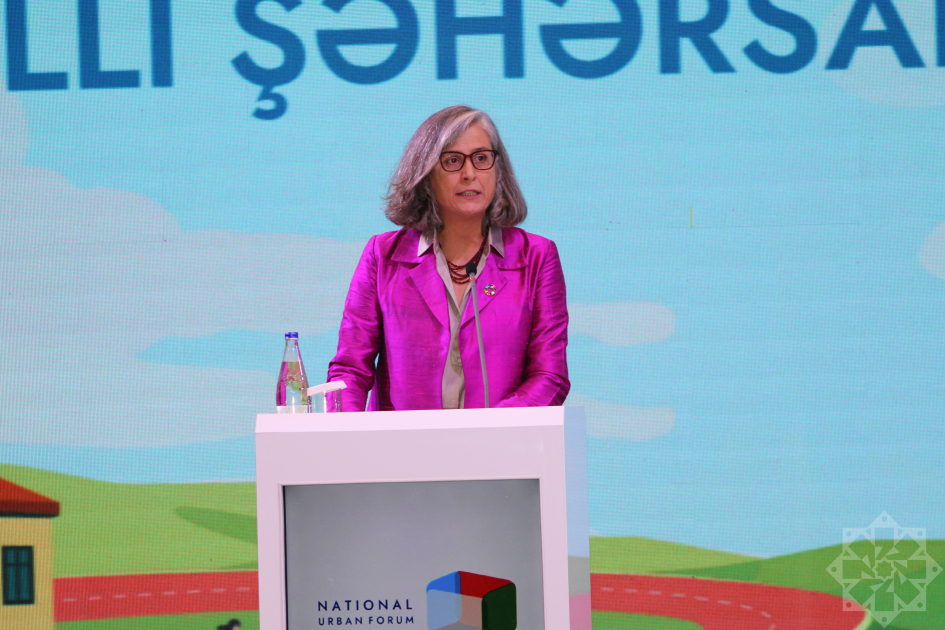
Anar Guliyev noted that the forum has gathered nearly 400 participants from around 60 countries. He emphasized that the event provides ample opportunities for exchanging expertise in urban development and is crucial for aligning Azerbaijan’s urbanization policy with global standards.
The forum also featured a video message from Nga Kor Ming, Minister of Housing and Local Government of Malaysia and UN-Habitat Assembly President. Panel discussions followed, bringing together representatives from government and private sector institutions, international organizations, academic institutions, and civil society.
The three-day event serves as a platform for local and international experts to discuss pressing challenges and opportunities in urban development. Key topics include resilient recovery after conflicts and natural disasters, housing provision, sustainable and healthy cities, ecological and energy-efficient practices, digitalization and innovation, the Sustainable Development Goals and the New Urban Agenda, and the advancement of regional and international partnerships.
As part of the forum, participants will be introduced to large-scale reconstruction and development projects in the Karabakh and East Zangezur economic regions, the application of modern urban planning standards and innovative technologies, Azerbaijan’s achievements in the post-conflict period, as well as leading practices from other countries. Discussions with prominent academic researchers in urbanism will further strengthen knowledge exchange and support evidence-based decision-making for sustainable urban outcomes.
The forum will conclude in Baku on October 17.